Birthstones by Month: Traditional vs Modern UK Guide for Jewellery Gifts
Choosing a birthstone ought to be simple. Find the month, buy the stone, hand it over. Then you look up March and find aquamarine on one list and bloodstone on another, and the tidy idea starts to wobble.
Both are correct. No single body governs birthstones. The list most jewellers work from today was drawn up by American jewellers in 1912 and has been revised since, while the "traditional" list is older and looser, stitched together from old English, Roman and biblical sources that never fully agreed with each other. Knowing the difference is what stops a thoughtful gift becoming a confusing one.
There is also a third thing worth saying early. Birthstones are a convention, not a rule. No jeweller will raise an eyebrow if you buy a peridot in February, and plenty of people simply choose the stone they like and quietly attach a meaning to it afterwards. The lists matter because they tell you what the recipient is likely to expect, not because anyone is checking.
Birthstones by month: the two lists side by side
Here is how the lists compare. Traditional choices vary by source, so treat the older stones as options rather than rules.
- January: garnet on both lists. Deep red is classic, but green, orange and pink garnets exist. Tough and good value.
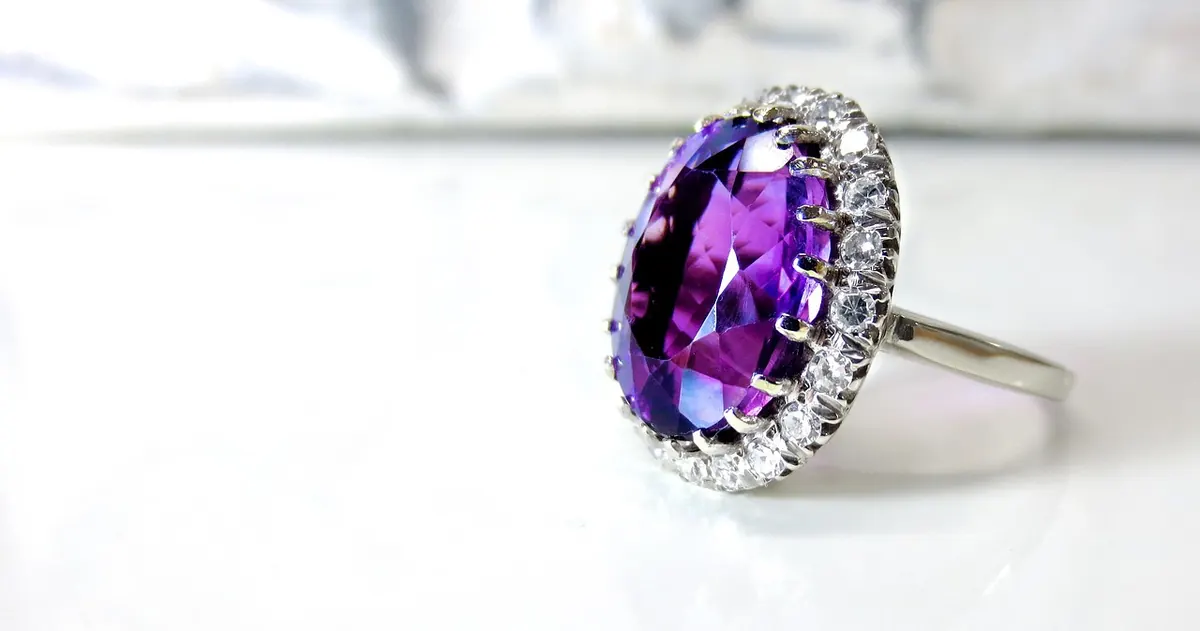
- February: amethyst on both. Purple quartz, easy to find, and one of the best-value stones in larger sizes.
- March: aquamarine (modern) or bloodstone (traditional). Aquamarine is what shops stock; bloodstone is dark green with red flecks.
- April: diamond (modern) or white sapphire (traditional). Lab-grown diamonds and moissanite are established alternatives.
- May: emerald on both, with agate on some traditional lists. Emerald is the one most people expect.
- June: pearl and moonstone on both, with alexandrite on the modern list. Pearls suit pendants and studs.
- July: ruby on both, with onyx on older traditional lists. Ruby remains the safest reading of the month.
- August: peridot (modern) or sardonyx (traditional), with spinel added to modern lists more recently.
- September: sapphire on both. Blue is standard, though pink, yellow and teal sapphires are worth a look.
- October: opal and tourmaline on the modern list; opal alone on older traditional ones.
- November: topaz and citrine. The lists broadly agree, and citrine is the better-value choice.
- December: turquoise and zircon, plus tanzanite on the modern list; lapis lazuli and ruby appear on traditional ones.
The months where the lists really diverge
March: aquamarine or bloodstone
Aquamarine is what nearly every UK jeweller will show you: a pale blue that sits well in silver, white gold and platinum. Bloodstone is the traditional answer, a dark opaque green flecked with red, better suited to a signet ring or a pair of cufflinks than a delicate pendant. If the recipient has never mentioned bloodstone, buy aquamarine.
One practical note: aquamarine is a hard stone at around 7.5 to 8 on the Mohs scale, but it can chip along internal flaws if it takes a sharp knock, and the icy pale shades show scratches less than the deeper blues. Bloodstone, being a form of chalcedony, is quietly tough but dislikes ultrasonic cleaners and harsh chemicals, which can dull the red flecks.
April: diamond or sapphire
April is the month where budget does most of the deciding. Diamond is the modern stone; white sapphire is the older choice and gives a similar icy look for far less. Lab-grown diamonds and moissanite are both well established now, and neither looks out of place in a UK high street window.
If you are weighing them up, the honest difference is wear, not looks. Diamond sits at 10 on the Mohs scale, white sapphire at 9. In practice both will survive decades in a ring. Sapphire has slightly less of the "fire" that makes a diamond sparkle across a room, and it needs cleaning more often because it holds a film of hand cream and soap more readily. For a pendant or earrings, that gap barely matters.
August: peridot, sardonyx or spinel
Peridot is the modern pick, a bright lime-green stone that flatters warm skin tones and tends to be good value. Sardonyx, the traditional option, is banded brown and red, handsome in men's jewellery and harder to track down. Pink spinel, added to modern lists more recently, is worth asking about.
Peridot deserves a word of caution. It is softer than it looks at around 6.5 to 7, and it is prone to chipping along internal cleavage planes, so it makes a better pair of studs or a pendant than a ring worn daily against door handles and gym equipment. Spinel, by contrast, is a tough 8 and is quietly one of the most underrated stones on any list.
October: opal, tourmaline and everything in between
October is the most generous month. Opal is the romantic choice, but it is also the most delicate stone in this article at roughly 5.5 to 6.5, and it can craze, meaning it develops a network of fine cracks, if it dries out or is stored badly. A solid opal that is worn and handled regularly often ages better than one left in a drawer for years.
Tourmaline, the modern addition, is the pragmatic answer: harder, tougher and available in more colours than almost any other gemstone. If the gift is a ring for someone who never takes it off, buy tourmaline.
December: turquoise, zircon, tanzanite and lapis
December has the longest and most contradictory list of the year. Turquoise and zircon are shared; tanzanite appears on modern lists; lapis lazuli and ruby turn up on older ones. Turquoise is porous and dislikes perfume, hairspray and chlorine, so it suits a brooch or a pendant better than a ring. Tanzanite is beautiful and rare, but at 6 to 7 with one clear cleavage direction it is fragile in a ring and far safer as earrings. Zircon, often confused with cubic zirconia, is a genuinely lovely natural stone with more sparkle than its reputation suggests.
How to choose when the lists disagree
Four questions settle almost every case.
- What will they wear, and how often? Rings take knocks. Earrings and pendants do not. Match the stone's hardness to the job.
- Did they ask for a specific stone? If so, use it. If they said "my birthstone", they most likely mean the modern one.
- What is the budget doing? April, May, and September get expensive fast. The traditional alternatives exist precisely because they offer the same look for less.
- Do they like the stone? This outranks everything. A perfectly correct ruby that sits unworn is a worse gift than a "wrong" citrine that gets worn every week.
Hardness, care and the UK hallmark
Hardness is not the only measure of toughness, but it is the one that predicts how a piece will look in five years. A stone below 7 will scratch and dull with daily wear; anything below 6 needs a setting that protects it. Setting matters as much as the stone: a bezel or a halo hides and shields the edges, while a high claw setting exposes them.
In the UK, buy from a jeweller who will talk about hallmarks openly. Precious metal items over the legal weight threshold must be assayed and stamped at one of the UK assay offices, with marks showing the metal fineness: 925 for sterling silver, 375 for 9ct gold, 750 for 18ct, 950 for platinum. Ask too whether the stone has been treated, since emeralds are commonly oiled, opals can be treated, and laboratory-grown diamonds should always be disclosed as such. A good retailer will tell you without being pressed.
A birthstone is a starting point, not a test. The best gift is the stone they will actually wear, in a setting that survives being worn.
So when the lists disagree, take the disagreement as a licence rather than a problem. Buy aquamarine for March unless you know they love dark green. Buy white sapphire for April unless the diamond is the point. Then spend the money you save on a better setting, because that is the part the stone spends its life inside. The list gives you a reason; the piece itself has to do the rest.
Photo: sarakgraves / Pixabay