How to Tell Real Quartz from Glass and Resin: A 6-Step Home Test
You have a clear quartz point in your hand. It is cool, it catches the light, and the seller told you it came out of a mine rather than a factory. Maybe it did. It might equally be moulded glass or cast resin, and both are sold by the boxload at markets, gift shops and online listings that never quite promise anything in writing.
The good news is that six checks will catch the great majority of fakes, and none of them needs a laboratory. Most take seconds. One needs an empty bottle and a steady hand. No single test is proof on its own, but when two or three agree, you can relax and enjoy the stone.
1. Start with the shape, then distrust it
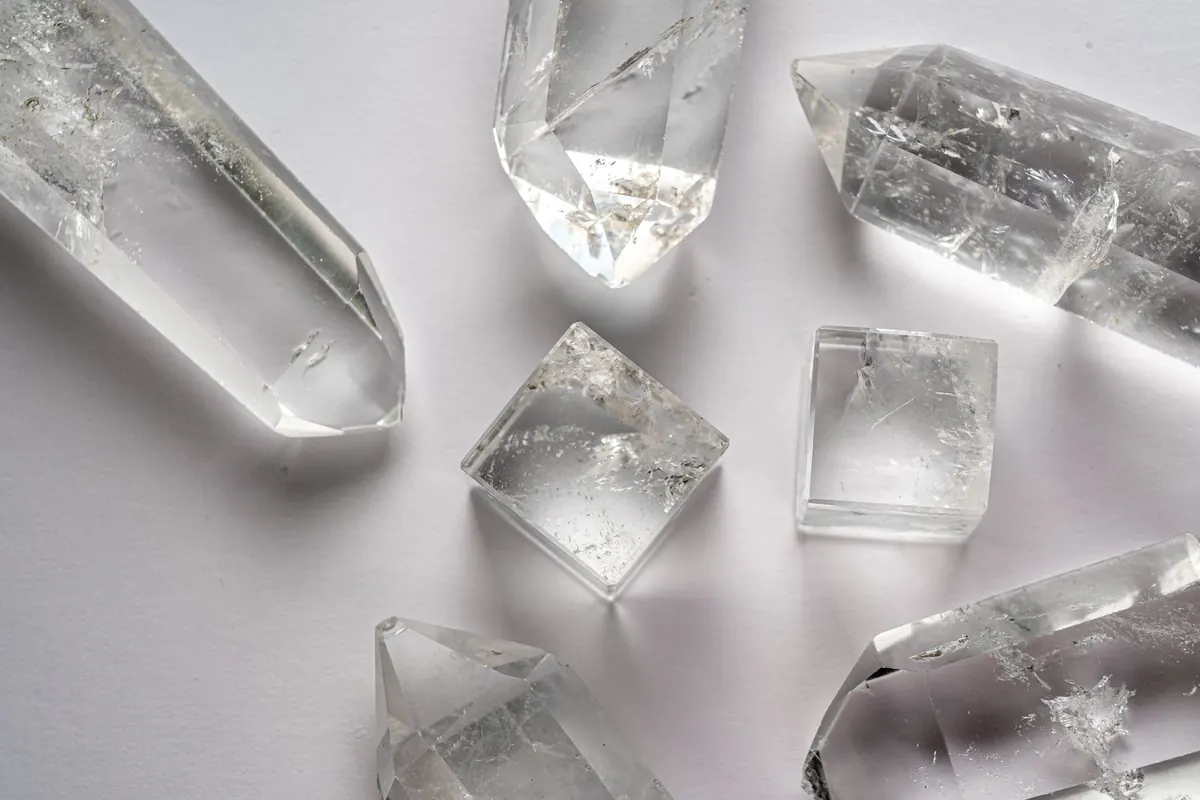
A natural quartz point is a hexagonal prism topped with a pyramid — six sides, six faces meeting at the tip. Good specimens show fine horizontal striations along the prism faces, a slightly frosted or milky skin, small chips and bruises on the edges, and a base that was knocked or broken off the cluster it grew on.
Glass points tend to be too neat. Perfectly symmetrical, rounded shoulders, no striations, a flat polished base, and sometimes a faint mould seam running up one side. Resin is neat as well, and slightly soft — press a fingernail into a hidden edge and it may leave a dent you can feel.
The catch is that some glass points are cast in hexagonal moulds, and some real quartz has been cut and polished into someone else's idea of a perfect crystal. Treat shape as a filter, not a verdict.
2. Temperature: the cool-hand test
Quartz moves heat slowly. Hold a point loosely in your fist and it should feel distinctly cold at first, then stay cool for a while, warming gradually. Glass starts cold too but warms up faster. Resin feels warm almost immediately, like a bead of plastic that has been in your pocket.
Two things spoil this test. A crystal left on a sunny windowsill all afternoon will not feel cold, and one straight from your coat pocket will feel warm whatever it is made of. Let the piece rest on a cool surface for five minutes and test it with a hand that has not just been in a pocket or around a mug of tea.
Temperature alone will not separate quartz from glass — both start cold. It is very good at catching resin, though, and that is worth knowing before you spend more time on the stone.
3. Look inside: bubbles, veils and pleasant chaos
A jeweller's loupe at 10x costs very little and is the single best piece of kit you can own. A phone camera in macro mode will also do at a push. Real quartz is messy inside, and that mess is reassuring. Look for:
- Angular fractures and flat cloudy planes — often called veils — where the crystal cracked and healed millions of years ago.
- Hazy patches and milky zones, usually thicker near the base, with clearer windows in the middle.
- Needle-like rutile, dark specks of chlorite or tourmaline, and occasionally a bubble that moves inside a pocket of liquid.
- Bubbles that are irregular, stretched, or pinned against a fracture.
Glass tells a different story: round, perfectly spherical bubbles, often in clusters, frequently stretched along the surface where the mould was filled. Resin can be full of bubbles too, but usually with a soft, swirly cloudiness and a waxy surface shine. If the bubbles are round and even, assume glass or resin until something else proves otherwise.
4. The scratch test, done carefully
Quartz sits at 7 on the Mohs hardness scale, ordinary glass is around 5.5, and resin is softer still. That gap is what makes this test work.
Find a piece of waste glass — an empty bottle, a jam jar, a scrap of window glass. Hold the crystal like a pen, press the point or a sharp edge firmly against the glass, and drag it once in a single direction.
- A firm groove you can feel with a fingernail means the material is harder than glass, which rules out resin and makes genuine quartz very likely.
- If the crystal skates across without leaving a mark, treat it as suspect. Glass can sometimes leave a faint scuff, so look for a real scratched line rather than a smear.
- Never do this on the tip of a crystal you care about, on a polished face, or on a phone screen.
Remember what the test can and cannot tell you. A groove proves hardness, not identity — plenty of stones are harder than glass. But between the fakes you are likely to meet, it is more than enough.
5. The double-vision trick
Quartz is doubly refractive, which means it splits light into two paths. Glass does not. The effect is easiest to see with a clear polished sphere or a slab with two reasonably flat, parallel faces, though a clean point with a flat base will sometimes show it.
Place the stone over a printed line or a piece of fine text in good daylight, look down through it, and rotate slowly. With quartz the line should split into two, or a faint ghost image should appear alongside the original. Glass gives you one clean line and nothing more. Cloudy or heavily included quartz will not show the effect, so a blank result here means nothing on its own.
6. Weight, sound and the fingernail
Quartz and glass have similar densities, so a glass point can feel reassuringly heavy in the hand. Do not trust heft to separate those two. It will catch resin every time, though, because resin is dramatically lighter than either.
Tap the point gently against another crystal or a hard surface. Quartz gives a clear, high, glassy ring that lasts a moment. Glass sounds duller and shorter. Resin thuds. Finally, try a fingernail on an inconspicuous edge: quartz will not care, because a fingernail is far softer, while resin will take a visible mark.
Putting the results together
Genuine quartz usually passes four or five of these checks: natural hexagonal shape, cool to the hand, chaotic inclusions with no round bubbles, a groove on waste glass, and a clear ring when tapped. Resin fails three or four at once. Glass often passes the shape and temperature tests but fails on bubbles and double refraction.
Two useful caveats. First, dyed, heat-treated, irradiated or aura-coated quartz is still quartz — those are enhancements rather than fakes, though a good seller should tell you. A coating will also hide the scratch test and the double-vision trick. Second, no home test settles everything. If you are spending serious money, ask for a gemmologist's report, buy from a seller with a clear returns policy, or take the piece to a jeweller who can check it with a refractometer in seconds. Keep cleaning simple in the meantime: warm water, a soft brush, and no acids or ultrasonic tanks on fragile specimens. If a seller makes health claims about a stone, treat those separately from questions of authenticity, and speak to a qualified healthcare professional about any medical concern.
Photo: Castorly Stock / Pexels